Ad block

Weekly Briefing: Friday, January 24, 2020

BRIAN SANTO: I’m Brian Santo, EE Times Editor in Chief, and you’re listening to EE Times on Air. This is your Briefing for the week ending January 24th.

In this episode…

During its first few decades, AMD acted like Intel’s kid brother, tagging along and mimicking whatever Intel did. Recently, however, the company has established a reputation for independent innovation. This week we’ve got an interview with AMD CTO Mark Papermaster, one of the architects of the bold new AMD…

…also – a conversation with Ron Black, the CEO of Imagination Technologies, which seems to have its fingers in nearly every emerging technological trend out there…

…and our editorial director, Bolaji Ojo, checks in with the key question for the electronics industry in 2020: Where should everyone spend their money?

AMD was among the early wave of semiconductor companies born in late ‘60s and early ‘70s, many founded by former employees of Fairchild Semiconductor. Other companies from that era – National Semiconductor, LSI Logic, Mostek – are gone (as is Fairchild itself), but AMD has been remarkably resilient across the decades.

Over the years, AMD has mostly prospered, largely by offering itself as an alternative to Intel. But compared to Intel, AMD’s corporate strategies and management never appeared quite as steady. In 2006, AMD bought into the graphics processing segment of the market with the acquisition of ATI. In the summer of 2014, the company reorganized into two business groups: one was Computing, the other was Graphics. At roughly the same time, AMD hired Lisa Su as CEO. She encouraged the company to be far more ambitious. And just as AMD began delivering on those ambitions, Intel appeared to start stumbling.

At the Consumer Electronics Show a couple of weeks ago, Intel offered some details about previously announced next-generation products, but was vague about when they’ll all hit the market. In contrast, AMD introduced a slate of bold new products, most of them with specific launch dates. They included the Ryzen 4000 mobile CPU, the Threadripper 3990X high-end desktop chip (or HEDT) and the Radeon RX 5600 XT graphics card.

Mark Papermaster is AMD’s chief technology officer. He’s been helping to guide AMD’s technological roadmap for years. International correspondent Nitin Dahad caught up with Papermaster shortly after AMD’s presentation at CES. Nitin asked him about AMD’s new products.

MARK D. PAPERMASTER: It’s really an exciting time in the industry because what you’re seeing is a confluence of where we’re all being really in overload mode of the kind of the data that we’re being bombarded with every day. You know, you have IoT devices literally everywhere. It used to be that we had the big change of all being connected with cell phones, but now all the devices around us are smart, and they’re generating a ton of data. And in industrial applications as well. We put sensors on, and are creating really an inexorable demand for more and more high-performance computing. So that’s what we’re focused on in AMD.

That trend in the industry has driven us to put a roadmap together of a family of CPUs around our Zen, our family of GPUs, around our Radeon DNA architecture, and we’re rolling our extensions of our Navi product line. And it’s focused on really keeping AMD on or ahead of a Moore’s Law pace of doubling performance at a given cost point every 18 to 24 months, even while the traditional factors that helped Moore’s Law with new foundry technology nodes are changing. We don’t get all the same benefit we used to with those technology nodes.

So that’s why it’s so exciting for us. It’s driving innovation. It’s driving us to take new approaches like chiplets, putting different components in different technologies and assembling systems across a chiplet approach like we did on our new second-generation server like you saw, in fact, on the 64 core Threadripper that we just announced this week. That’s what excites the engineers at AMD. How to bring innovation to deliver enhanced experience and computing capabilities for our customers.

NITIN DAHAD: Your CEO, Lisa, talked about the gains in the processor, being both from the 7 nanometer process, but also design architecture improvements. Are you able to say anything about that?

MARK D. PAPERMASTER: Yeah. Going forward, it is so important to, obviously, reap the benefit of each new technology node. And that gives us a density at each new node. So you saw in our Ryzen 4000 we were able to pack in eight second-generation Zen cores, eight graphic compute units, and optimize it and bring it all the way down to a 15 watt, ultrathin laptop form factor. So it is about marrying the architectures, the CPU and GPU architectures, with the process technology. But equally, it’s about that whole system optimization. So we work closely with OEMs, delivering the right form factors. And then, of course, the software stack. They can deliver the end experience.

NITIN DAHAD: Is there room for new architectures do you think as you go forward?

MARK D. PAPERMASTER: Nitin, that’s a great question. With this just huge demand for more computing, what you’ll see is no abatement in the need for traditional CPUs and GPUs. You have all of the coding standards and the legacy of code that will demand more and more compute capability and emerging applications that can leverage that economy of scale of our X86 CPUs and of our GPUs. Yet we are seeing our workloads that can benefit from specialized architectures. And so what we’re doing at AMD is making sure that we can easily attach to startups and new architectures that are coming out there. For instance, to accelerate AI workloads that work in tandem with traditional computing architectures.

NITIN DAHAD: And when you say “new startups,” you’re taking about starts using the alternative architectures as well?

MARK D. PAPERMASTER: Sure. First of all, you have programmable devices like FPGAs that allow people to really experiment and try new approaches and new architectures. And then as those prove out, they’re often hardened into an application-specific IC. And so we would like to see a robust innovation ecosystem that can create these type of accelerator devices with our CPU and GPU products.

NITIN DAHAD: And does that mean like X86, ARM and RISC-V sitting together?

MARK D. PAPERMASTER: You have that today. You look at our security processor that we have across our chips. We partner with ARM. We leverage ARM trust zone. And we have many microcontrollers on our devices, so you actually already have a robust mixed architecture approach in devices today.

NITIN DAHAD: I’m going to ask you a question. Probably don’t expect an answer, but what can we see more of from AMD this year?

MARK D. PAPERMASTER: What you’re going to see is very exciting. We started a rollout last year of our 7 nanometer across our portfolio. We’re so excited this year to continue that. It starts with the Ryzen 4000, and extending our Navi product line. And you’ll see us really complete that portfolio top to bottom at the close of ’20. And we’re right on track on our next generation. So we’ve been very public on our Zen roadmap, and we’ve said that here we are shipping Zen 2 today, and our Zen 3 is right on track. And likewise on our graphics roadmap. We’re incredibly focused on our execution and getting each generation out to the market exactly when we promised it.

NITIN DAHAD: Mark, thank you very much.

MARK D. PAPERMASTER: Thank, Nitin.

BRIAN SANTO: AMD certainly impressed people with the products it announced this month. Some reviewers went hyperbolic, using terms like “monstrous,” “insane” and “stupid fast” to praise the new processors. Moving forward, EE Times will stay on top of how AMD’s competitors – especially Intel – try to respond.

Imagination Technologies got an immense boost years ago when it became a key supplier of electronic components for Apple’s iPhone. Imagination took a commensurate hit in 2017 when Apple said it was going to wean itself from Imagination’s products over the ensuing two years. Well, those two years have elapsed, and then a funny thing happened: Apple came back and renewed the relationship at the beginning of January. The press release lacked details, however.

Nitin Dahad caught up with Imagination’s CEO Ron Black, and asked about the resumption of the relationship and how it happened. This was Black’s response:

RON BLACK: We said everything we could say in the press release.

DAVID HAROLD: Yeah, Siri is always listening. You know that, right? We can’t add any color.

BRIAN SANTO: That second voice you just heard belongs to David Harold, Imagination’s VP of marketing. Since it was clear that Apple had closed that conversational avenue, Nitin shifted gears, asking Black about the rest of Imagination’s business. The response was an interesting overview of many of the other major technology trends are developing today.

RON BLACK: I’m particularly excited about the automotive industry and the advanced things that they’re doing. We have an outstanding position in automotive, and we’re looking to expand that. I think there’s a very interesting thing in those driving pixels, but also the autonomous driving and ADAS functionalities. So it’s just making the car safer. And that’s the type of thing that we really like to do. Technology that benefits humanity. Makes a difference in people’s lives. And the automotive industry is going that.

Now, we had a tough year last year. There was a lot of redundancies announced, but we’re quite confident it’s going to rebound back and it’s going to be a great opportunity for Imagination.

Besides automotive, we’re very interested, especially with the A Class GPUs, in looking towards the edge and data centers. The edge in a 5G context, we think that can change the computing paradigms, because you had high-bandwidth, low-latency everyplace. So some of the functionality that you think about doing today only in the data center or only in a mobile device, you can partition.

One of those is ray tracing. We have an outstanding position in ray tracing. We’ve been doing it for a decade or so. But we were early, we were too early. We actually had it on hold a little bit a few years ago, but we’ve been bringing it back over the last couple of years. We’ve opened it up for architectural licenses, so any GPU. We’re willing to license to anybody. I think it’s a great thing to take a license, because we have an incredible patent portfolio. That’s another area I’m investing in heavily, is patents. (Or “pay-tents,” as the British say.) So ray tracing is interesting.

It’s not just ray tracing for gaming. It’s ray tracing like in automotive. The automotive vendors are really interested in ray tracing, because as you render the cars on the screen, that’s their brand. That’s associated with how they look at things.

So those are kind of the major vectors. We have a smaller initiative today in RISC-V. We’re replacing all of our MIPS and meta cores, smaller microcontrollers that are in the GPUs. But I’m really interested in this space. Customers have been asking us to look at doing higher-end parts, so that’s an area we’re investigating. Watch that space.

NITIN DAHAD: I’ve seen a couple of different answers from you and a couple of other players, which I’ve written about last year behind the RISC-V ecosystems. So I’m guessing, if you’re going towards the edge and you need to do a lot of that stuff, the legacy stuff, is that too heavy in terms of the silicon state and things like that?

RON BLACK: I think RISC-V is modern architecture and the ecosystem is just gaining a lot of momentum over the last three to four years. I’ve been looking at it closely for five years. Five years ago, I thought it was a little soon. Today, I think there’s just so much momentum behind it. And customers are very interested in looking at different aspects of it. All the way up into very high-end application processors.

DAVID HAROLD: I think it’s safe to say that the firmware-type processors that were in our earlier GPUs were pretty simple. But actually now we have automotive-grade products, and the requirements in automotive in areas like self-test and some of the security are more advanced, and you need a bit more processing in there. RISC-V really sort of fits the bill for that.

RON BLACK: Yeah. One of the things, Nitin, that you’re probably going to see the industry talk about a lot more, and certainly us, is secure, heterogeneous computing. Secure all the way down from the device. It’s a hardware route of trust. All the way up to the network, to the cloud, to the applications. And binding applications to specific devices. So that’s a big area of focus for us. And heterogeneous in the sense of CPU, GPU and then various accelerators, many for AI applications. We have a very powerful neuronetwork accelerator that’s gaining a lot of traction.

And interestingly, first I thought it was going to be mainly a hardware play, but it’s the software. The software’s incredibly complex. The ecosystems are still developing. And when customers come to us, it’s usually because they love the fact that we have an API that transcends the GPUs and the neuronetwork accelerator. So you have an algorithm that’s evolving, you can run some of it on the GPU. If it’s not evolving, you can really focus in on the neuronetwork accelerator, get an absolutely dominant PPA.

NITIN DAHAD: I think what I’ve heard from you now is automotive is a big play for you. One doesn’t normally associate the traditional graphics pedigree that you’ve come from, and with automotive now it’s becoming clear.

DAVID HAROLD: You know what a phone and a car have as a similarity? It’s the heat. In a mobile phone, you don’t want something burning through your pocket. In the car, you can’t have hot spots. You can’t have risk of failure caused by heat, you can’t have a risk of fire caused by heat. So actually a car manufacturer is very interested in a lot of the same things that have made us so successful in mobile.

RON BLACK: I would say that most of the cars are moving away from the clusters with the normal dials, and they’re moving toward screens. And you look at some of the advanced cars. They have screens everyplace. Consoles, clusters, just the entire car. And so you are driving a lot of pixels in the cars. And then the functionality of course gets used for all the way up through autonomous driving-type functionality.

DAVID HAROLD: This isn’t a niche thing at all. We have the top three cars selling today use our technology.

NITIN DAHAD: I saw an amazing display yesterday. Three screens on a car. And pretty high-performance graphics. And that was being driven by one system, on module.

DAVID HAROLD: It is. So we have this thing called “hyperlane” in the A Series, which basically lets you drive multiple displays. It treats your GPU as if it’s multiple GPUs. Up to eight, in fact. Which is basically us saying to car manufacturers, “How many screens do you need?” And they go, “Four.” We’re like, “Okay, we’d better double that.” So we have that ability to drive multiple displays, and I think that’s going actually get more and more prevalent in a car. Some of the manufacturers we’re talking to think they’re going to put 400% more electronics into their cars over the next few years. It’s a massive growth opportunity.

NITIN DAHAD: I quite liked the hyperlane when I rode in it. It’s sort of like the parallel processing gone crazy.

DAVID HAROLD: The heart of that isn’t the ability to have multiple workloads. It’s the ability to guarantee quality of service. So in the car, there are certain things that always have to work. So your speedo. If that isn’t telling you the correct speed, you have a serious problem. So you need to guarantee that workload will always be fulfilled.

But then something else, maybe as a lower priority, and it can once in a while drop its frame rate, so whatever else the demands are different in the system. And our ability to guarantee and to partition that is really what hyperlaning is all about.

NITIN DAHAD: Automotive is a big thing, but connectivity is also a big thing. You touched on the opportunity in 5G with the edge processing. Maybe ray tracing at the edge. So tell me a little bit about the vision for connectivity this coming year.

RON BLACK: We changed the strategy when I joined the company. They had previously wanted to divest the Insigma product line. I didn’t think that was the right idea. There was a lot of premier accounts that are in interested in it. And connected microcontrollers are now all in vogue. And clearly we’re focused on a very specific set of applications. That’s mostly around power-efficient WiFi and Bluetooth low energy. We’re not trying to do kind of mobile device things. It’s really about the broader market and IoT connectivity. We’ve narrowed the focus of the team, and the customers are just responding incredibly well. There’s lot of innovation people looking at us. And that’s probably the biggest theme about Imagination. I’ve known the company for many, many years, but I didn’t really appreciate how innovative it is.

And there’s so much innovation. We just created IMG Labs. So it’s a labs function whose focus… Today, a lot of it is on ray tracing, extensions of ray tracing. But there’s a security thrust, there’s the heterogeneous computing thrust. We’re really looking to hire all of these big brained PhD types to compliment all of the staff that we have. So it’s about innovation. And in many ways, which is nice about it, it’s fun and socially responsible innovation. Because the product sets that we have… Think gaming. It’s fun. But then we can use the same GPUs to make the cars smarter so that they avoid collisions. So it’s socially responsible. That combination is truly unique.

NITIN DAHAD: In terms of business, is it still very much still third-third-third US-Europe-Asia? Or are you sort of like steering towards Asia now because of a lot of what’s happening?

RON BLACK: Asia’s actually a smaller part. It’s the US is still the largest, then Europe, then Asia. China, in general, is a very interesting area for everybody, just because of the investment that they’re putting into it. And when you’re building all these fabs and all sorts of semiconductor companies that are popping up, you need IP. And most of the time things like GPUs are just so hard. We have upwards of a thousand people working on these things. It just doesn’t make sense for every company to do. It makes sense for companies to license it.

So we see China as a very big area. We’re investing heavily in China to grow, both in an R&D standpoint and commercial customer support across all of the product lines.

NITIN DAHAD: I know ARM and SciFive, they’ve both set up different trading entities now in China. Have you done that?

RON BLACK: We’ve always just had a China headquarters there. So it’s not a separate entity. I don’t really think that that’s the appropriate way to set it up. In fact, several customers have told us they prefer it not to be that way. Because you don’t want to have two independent companies trying to accomplish the same thing. You really want to bring the full bulk of the company. We are very independent on management style. We push from decision making down. There’s more autonomous. We agree on the objectives, and then everybody executes ruthlessly in that direction. So there’s a lot of autonomy in the regions, but we really put the whole company behind it.

NITIN DAHAD: Okay, lastly. New decade. Everybody’s made lots of predictions. What’s your vision of the coming decade? And then maybe you can relate it back to Imagination if you like as well.

RON BLACK: I hate the kind of “vision” type of statements. I always found that CEOs that pontificate about vision or get their faces on magazines, you should probably short those companies, because they are spending too much time. Our focus is more on ruthless execution around where we have demonstrable value to customers. So it’s a lot of customer focus, listening to the customers, and then just ruthlessly executing. I think we’re proving that we’re doing that. So that’s really exciting.

I think clearly, as Dennard Scaling and Moore’s Law falls off, there’s going to be a change. Five nanometers A6 will cost half a billion dollars. There’s not a lot of companies can do that. So I think chiplets is the way to go. I’ve been working in chiplets in one way, form or another for six years, when I believed that it was the time to go. We have internal designs that we’re undertaking now in a chiplet context. So I think that’s going to be a major trend.

You know, the other part that I think is super important (I’m not ready to announce anything yet.), but you’re going to see us do a lot more in software. It’s a very natural thing when you thing about our customers are semiconductor companies, but a lot of times they ask them to work with them, say in the automotive space, to help the car manufacturers tailor their ECUs to leverage our GPUs. So that’s a very natural extension, is to offer tools and technical support to the customer’s customers. And that naturally evolves into software businesses.

NITIN DAHAD: Interesting. I’ve heard this quite a lot. Chiplets. I think that’s a very sort of… I just interviewed another CTO yesterday who was talking about the heterogeneous architectures that we’re going to see a lot more of, especially with the data center as well as the edge.

RON BLACK: Absolutely. We see that across the board.

NITIN DAHAD: Well, Ron, thank you very much.

BRIAN SANTO: You just heard Ron Black say that Imagination is going to replace all of its MIPS IP with RISC-V cores. What does that mean, exactly?

Recall that Imagination Technologies acquired MIPS in 2013. Imagination’s big ambition then was to become an IP power house – similar to Arm – having both graphics and CPU cores under one roof. But that dream never came true, and only four years after acquiring MIPS, Imagination turned around and sold it to Tallwood Venture Capital.

In 2018, Wave Computing bought MIPS from Tallwood, with a plan for MIPS to go open-source. Wave itself went under last fall.

Black was referring to “MIPS cores used as firmware processors in PowerVR GPU designs.” So Imagination will be replacing those with RISC-V cores developed by Imagination in house.”

Earlier in the podcast, we mentioned a handful of the once-mighty semiconductor companies that disappeared over the years. Black’s comment to Nitin means that another famous name in semiconductors – MIPS Technologies – is about to join those others on the wayside.

Earlier this week, our colleague Bolaji Ojo was named publisher and editor-in-chief of Aspencore. Aspencore is the global publishing company that owns EE Times. Bola is a veteran journalist who has covered the electronics industry for so long he won’t tell us precisely how long it’s been. Every once in a while, he comes and visits us here at our luxurious studios at EE Times Central, and every time he visits, he’s got some big ideas to unload. Here we are with International editor Junko Yoshida.

JUNKO YOSHIDA: Bola, what’s on your mind?

BOLAJI OJO: Well today, Junko, first I’d like to kind of celebrate Aspencore. I think probably that’s the first thing on my mind. You were at CES with Brian and with David Benjamin and Nitin Dahad and a whole host of teams from Aspencore. We were probably one of the largest technology media teams at that event. To kudos to the team! You guys really rock! You did a great and a fantastic job out there.

Now: In the spirit of “What have you done for me today?”, I can tell you that what’s on mind next as your co-conspirator Editor-in-Chief, is where I’m sending my reporters next. So, Junko, you are off to Barcelona to attend the Mobile World Congress. Brian is going to be holding down the fort back home in the West Coast of the US. Nitin Dahad is going to be at the Embedded World Congress with Sally Ward-Foxton. Mauricio Depaulo Emilio, our famous Italian engineer, is also going to be at the Embedded World event in Germany. So we are fanning out across the globe. And the reason we’re fanning out across the globe is that we need to know what’s happening, we need to represent our readers and we need to tell them all about the new things that are going on the world of technology.

Now, in order for us to do that, though, we should go back in time. All right? Brian, I’ve got a question for you. How many decades now can you count that semiconductors, if you can just kind of approximate the timing when the semiconductor industry could be said to have caramelized. How many decades now?

BRIAN SANTO: Now, my initial answer was six decades, going back to the early 70s with AMD and Intel. But you’re already told me that I’m wrong about that.

BOLAJI OJO: And the person who corrected me: Malcolm Penn, the CEO of Future Horizons, which is a research firm based in the UK. So I was in London last week attending that event, and Malcolm, he’s not in his 80s yet, but he has seen several decades of this industry, and he’s somebody worth listening to.

So one of the questions that he asked at that event had to do with what is driving the semiconductor industry today. So that’s part of what’s on my mind. And rather than I give you his answer, I’d like to ask Junko. Junko, what do you think is driving the semiconductor market today?

JUNKO YOSHIDA: You know, I think it’s new devices and new applications that are enabled by new devices. Brian said five, six decades ago. We didn’t even have a smartphone. Think about that. All the electronics that go into that little device, we didn’t even think that PC was going to be that big 60 years ago, right? So I think those are the new generation of devices and the applications that those devices enable.

BOLAJI OJO: Apps. Apps, apps, apps. Apps are the ones driving the semiconductor market today. You nailed it, Junko! Of course I expected you to do that. You nailed it! And the reason why it’s different today: This is not your old market from the 1970s or the 80s driven by the PCs or smartphones. It’s the apps. And the reason why… Malcolm’s conclusion was that the semiconductor market is more and more driven by the global economy nowadays. And the reason for that are the apps. Those apps are the ones that have now cut across all segments of the economy.

On your app, you can book a flight. You can buy insurance. You can buy a car. You can have Amazon ship you anything anywhere that you want. There’s a lot more that we do on these apps. They’ve basically cut a line right through the economy.

So now the question for me: When you said, “What’s on your mind?”, data. That’s what’s on my mind. Because they are generated by all of these apps. And the problem… There are humongous problems arising from the usage of data. One of the things that Malcolm said, Malcolm Penn said at this event, he said, and I thought that was kind of interesting, and it kind of sets the tone for what we’re going have to deal with as an industry in the future. He said, and I’m quoting, “It is unrealistic to expect data to be perfect. If data is not perfect, we’ve got a problem on our hands.”

So what is the reasoning? Why is data not perfect? And what happens when data isn’t perfect? Are we being realistic in looking for perfect data? Junko, you write about automotive all the time.

JUNKO YOSHIDA: What do you mean by data not being perfect? Do you mean data not being perfectly captured? Or data has a lot of noise? What do you mean by that?

BOLAJI OJO: All of that. It’s not perfectly captured. So even the sensors. You write about autonomous vehicles all the time. The sensors. What kind of data are they getting? And has it been properly interpreted? Who’s processing it? How much of it can any device process at any point in time? How do you use it? And how do you use it across the economy? How do you use it at home? How do you use it in engineering? How do you use it in banking? How do you use it in finance? How do you use it at all? If it is not perfect? If you cannot be sure that the data you’ve collected can be relied up, do we know if it can be relied upon?

BRIAN SANTO: It’s the old garbage in/garbage out conundrum. That’s been around for a long, long time. And just by virtue of the fact that we’re relying on even more data and collecting more data, the danger of having garbage in or garbage out, either way, I imagine that compounds the problem, right?

JUNKO YOSHIDA: Yeah.

BOLAJI OJO: But we also depend on the data. So here’s the problem: So let’s suppose that from the collection point, the data is clean. So you put it in storage. And then somebody decides to go in and tamper with the data. That’s a bigger problem. Right, Junko?

JUNKO YOSHIDA: Yeah. Exactly. I think you bring an interesting point here. One is that, How do we protect data? But also, How do we, I think you mentioned, interpret? But annotation data, it’s been known in the world of AI, it’s very difficult. Right? You annotate data, somebody has to look at each data perceived by sensors and say, Oh, this is a man; this is relevant; this is not relevant. Some human has to go in to make that decision. And if that decision is not perfect, again, data is not perfect.

But one of the things that I was talking about with Brian is that when Brian and I were at CES, I was totally amazed about what a big presence Amazon Web Service had. AWS was everywhere! Amazon had it own huge booth, but AWS also had its huge booth in the automotive segment that was in the North Hall. Right? It’s right in the middle. I mean, it goes to show what I was saying: Data has become the core of the business, and whoever hosts that data on the web has enormous power now.

BOLAJI OJO: Everything that we do, everything that engineers do now, of course hardware remains important. But I believe that the core of today’s economy is, How much data can the hardware capture? And how will it be used?

So just leaving the issue of data aside for now, this is going to be a beautiful year as far as semiconductor growth is concerned. Unit shipments are going to be up. Revenue is also projected to go up. Now, there are folks that are saying 9%. Malcolm Penn is saying 10% minimum. And he’s saying it could be as high as 15 to 20 percent. Wow! That’s a good year ahead. Where should your money be if you are in the semiconductor market? Are you supposed to focus on memory? By the way, average pricing, going up. Memory is back. And when memory is back, semiconductors will get a good year. I’m certain of that.

But where is memory going? Going back into data. This is our life today.

BRIAN SANTO: Well, I think that’s where you put your money. You’ve got to spread your money. Because you’ve got to put the technology where it’s being used, and it’s being used literally everywhere. A lot of it is the smartphones, but you still need data collection points, you need data transmission points, you need all sorts of infrastructure to make sure that the data that’s running the economy, or at least there’s the underpinning of the economy, is able to collected and moved and processed. So you’ve got a lot of different points all along that chain. So when you say “memory explodes,” wonderful. But I think RF front ends and processing, the whole shebang should probably do well. It’s on an upward trajectory. If it’s this year, halleluiah. But it’s probably good for the next few years, too, I would imagine.

BOLAJI OJO: Personally, my money’s on power and energy. Because that’s the connecting wire for everything that you’ve talked about. Now, if I’m going to put my money on power, you know where I’m going to put it? In developing economies. They don’t have enough of it. It’s like the old story: Man lands in a place where they don’t wear shoes, and he’s like, “Please!” He calls headquarters and says, “Send me all the shoes you can! We need shoes here!” In developing economies, that’s where power is needed the most.

In the West, they already know how to generate power. So what is the argument? What’s the discussion? What’s the controversy in the West? In Germany, where I am today, the controversy is what type of power.

Okay, I’m going to bring my daughter in for a quick story. We were in Africa in December, and somebody said to her, “Well, everybody in Africa wants to move to the West. They want to move to Europe and America because they think the streets are paved with gold.” And this kid said to me, “Why would they want to move?” If you’re in a place where the streets are not even paved at all. You just want a paved road. Forget about it being paved with gold. You just want paved roads. Let’s start there.

It’s the same thing. If I have money to invest in power– which is going to drive data, which is the reason why we’re developing so much more of silicon and hardware in electronics– I would want to put that money into developing economies. Because that’s where they need that power to run the next set of electronics in this industry. That’s what’s on my mind.

It’s a happy mind this week, by the way, Junko. Nothing to complain about. We’re looking at some good growth ahead. I’ve got my editors spread all over the world. We’ve got a great story at Aspencore. Watch this space, Junko. Watch this space.

BRIAN SANTO: And now the moment you’ve all been waiting for: our weekly celebration of the anniversaries of great moments in electronics history.

Here’s the first time we’ve had a pair of related anniversaries. On January 22nd in 1984, a little computer company with a frivolous name bought a commercial spot during the Super Bowl. In the ad, Apple announced it would introduce its Macintosh personal computer in two days. The voiceover said the introduction would ensure that the year 1984 would NOT be like the novel “1984.” The bleak images of resigned conformity to authoritarian control were instantly interpreted the way Apple wanted them to be: as a reference to the leading personal computer maker, IBM. Apple immediately established the anti-authoritarian cred it has maintained to this day. The ad went a very long way to help the company win the loyalty of people who work in the arts, a small but well-defined community that Apple deliberately catered to.

The ad was immediately recognized for what it would turn out to be: one of the most famous ads in history. It aired on national TV just once. Now, a 30-second spot during that Super Bowl sold for $368,000, according to one source. A 30-second ad in this year’s Super Bowl, by the way, will go for $5 million.

Anybody remember who played in that Super Bowl? I’m giving you a few seconds here. Yeah, I see only a few of you in the studio audience are raising your hands. So who was it? Yeah, that’s right. The Oakland Raiders and the defending Super Bowl champions, the Washington Redskins. The Raiders won.

The director of the ad was a fellow named Ridley Scott. You might have heard of him; he’s still making successful movies.

The paired anniversary, with the anniversary of that ad? The actual introduction of the Macintosh computer two days later, on January 24th.

(BEEP SOUND EFFECT)

That was the amazingly brief startup ping from the first Mac, which came in a beige cabinet that measured roughly 14 by 10 by 11 inches. It was built around a 7.3 megahertz Motorola 68000, and it came with a 128K RAM. It wasn’t the first PC built to showcase a graphical user interface, but it was the first successful one. Or… relatively successful. It was priced at about $2,500, which made it far more expensive than many other machines – five times more expensive than a Radio Shack TRS model. It also didn’t have a lot of software.

Subsequently, Apple tried more unconventional marketing campaigns, but it kept fumbling. Its mis-steps included an ill-advised follow-up to the “1984” commercial, referred to as the “Lemmings” ad, which most potential customers found insulting. It sold well into the education and publishing markets, however, and though those were not the biggest markets for PCs to target, in terms of paving the way for the ongoing “cult of Mac,” the Macintosh was an unqualified success.

That’s your Weekly Briefing for the week ending January 24th. This podcast is Produced by Aspencore Studio. It was Engineered by Taylor Marvin and Greg McRae at Coupe Studios. The Segment Producer was Kaitie Huss.

The transcript of this podcast can be found on EETimes.com. You can find a new episode every Friday on our web site, or through any of the most popular places for podcasts. I’m Brian Santo. We’ll see you next week.

Taiwan’s TTA Takes Record 82 Startups To CES 2020

For the third year in a row, Taiwan had a significant presence at one of the biggest electronics trade fairs in the world, CES 2020. Leading a delegation of 82 startups presenting in Las Vegas, Taiwan Tech Arena (TTA) said it was their largest delegation ever, winning over US$226 million in business opportunities.

Speaking to EE Times Europe at CES, Dr. Yu-Chin Hsu, Deputy Minister, Ministry of Science and Technology, commented, “Taiwan has played an important role in the global high-tech ecosystem in the past 30 years. We have 82 startup teams covering three areas: artificial intelligence (AI), smart technologies, and also in healthcare.” Dr. Hsu emphasized the need for Taiwan and its startups to be connected to the global tech ecosystem in all key markets and applications, which is why presence at a major trade fair like CES is important. “We see that in the future in the AI age, there will be a lot of our startups that become important.”

In addition to promoting its leading startups overseas and connecting them to the global tech ecosystem, Taiwan’s government also works hard to ensure strong collaboration between academia and industry, especially since a lot of leading-edge research is carried out at Taiwan’s research institutes. At CES, we spoke to Dr. Chiou Chyou-Huey, Director General, Department of Academia-Industry Collaboration and Science Park Affairs, Ministry of Science and Technology, who commented, “The Ministry of Science and Technology of government highly encourages industry and academia collaboration. We do so by providing incentives, mentors, mature business models and business plans support.”

He added, “We also provide [academics with] some budget for them to take their scientific research to more mature products or services. Taiwan Tech Arena is a good hub to connect to the international market or international resources. Taiwan is very competitive in terms of talent and technology. That’s the reason why we bring a large delegation to attend CES.

A key focus of the TTA delegation was AI, smart technologies and healthcare. TTA supports startups by providing funding and a platform to grow their businesses. This year it gave the opportunity for startups in the healthcare industry to highlight how AI will improve the quality of lives. The startups which presented at CES 2020 are trying to disrupt current markets and push the boundaries of innovation.

Here we highlight some of the companies that we spoke to on the TTA booth at CES 2020, both in healthcare as well as AI and smart technologies in general.

Hipposcreen Neurotech: objective depression diagnosis

Hipposcreen Neurotech has developed a depression diagnosis system to provide an objective indicator of mental health of a patient, using a system it has developed for brain health assessment. The system combines an electroencephalogram (EEG) recording system and artificial intelligence (AI) algorithm to provide doctors with a way of rapidly measuring key indicators to identify the mental health of a patient. Using eight EEG electrodes to capture brain waves as input signals to an EEG amplifier, it uses an AI algorithm in the cloud to perform feature extraction and data analysis. Doctors can then view the data and assessment via a web portal within around two minutes.

At CES, the company told us, “We built this system to help doctors to carry out depression diagnosis, to save time and the doctor can also use this report to explain to the patient more easily and provide more accurate assessment results.” Its stress EEG assessment (SEA) system addresses a growing prevalence of major depressive disorder (MDD) and is expected to be used as an indicator of the level of MDD. The SEA system can achieve accuracy of higher than 80% on the EEG datasets collected as a result of collaboration between the department of psychiatry at National Taiwan University Hospital and Harvard Medical School (McLean Hospital).

Enosim Bio-Tech: an electronic “nose” detects disease

Enosim Bio-Tech has developed a real-time monitoring, breath detection and analysis system to identify ventilator-associated pneumonia (VAP). The core technology is a low power consumption nose-on-a-chip with software, integrated sensors, interface circuits, processors and memory. The breath analysis system uses data from a patient’s breath using the electronic nose to determine known diseases within its dataset. It overcomes environmental interference using a neuromorphic recognition algorithm.

Compared with traditional gas sensing, the e-nose does not use a single sensor, but instead uses multiple sensors to classify a gas. These sensors are combined into an array for odor recognition, and each of the different combinations represents a different odor. Compared with traditional gas analysis instruments, such as gas chromatography-mass spectrometry and Fourier-transform infrared spectroscopy, the e-nose system is easier to operate and to miniaturize.

The company said, “We are developing new technology to provide fast screening of diseases, by using your breath. If you have cancer or cancer cells, you have bacteria and these have multiple metabolisms, and there will be components existing in your breath. We are trying to detect these molecules.” The development of e-nose still poses many challenges in commercialization, including size and cost. Enosim’s electronic nose technology has been in development for over ten years and is looking to break through the technology bottlenecks.

Ventilator-associated pneumonia refers to a bacterial lung infection in intensive care units (ICU), where patients have been treated with a respirator for more than 48 hours. VAP is the most common nosocomial infection in ICU, and the rate of infection is about 7 to 14%. The mortality rate can reach from 35 to 90%. In ICU, there is an unmet medical need for rapid VAP identification.

RelaJet Tech: allowing people to hear in noisy environments

RelaJet Tech has developed the R1898 DSP, a complete solution for over-the-counter (OTC) hearing aids. The company said it has an AI acoustic fingerprinting engine which carries out edge processing on hearing aids. It said it can extract human voice characteristics within 10 milliseconds and amplify them so that people with hearing difficulties are still able to hear individual people talk in noisy environments. “Our focus of the company is to provide hearing aid solutions. Our key technology is what we call speech separation. We can separate the human voice from environmental noise within a millisecond using our DSP,” said a company spokesperson.

Through just 3-5 seconds of a recording, Relajet said it can label a specific voice, divide it and enhance it in real-time. It can also cancel certain sounds or noises and remove them in real-time. Finally, it can covert 2D sound into 3D – it does so by analyzing sound and environment, and then simulating 3D surround with its engine so that the user can ‘hear the space.’

Taiwan User-Friendly Sensor & Technology: food allergy detection

Existing point of care devices for food allergy detection can only detect gluten over 20 ppm, and hence lack the ability to quantify smaller concentrations. Taiwan User-Friendly Sensor & Technology has developed a point-of-care device based on connected electrochemical sensors, which can quantify targets below 10ppm for multiple proteins simultaneously. With its rapid extraction techniques, the device can readout data in less than two minutes, and costs just a few dollars per test, compared to the thousands of dollars and a few hours to carry out the gold standard ELISA (enzyme linked immunosorbent assay) tests for food allergy detection.

The company’s co-founder and CTO, Dr. Hsing-Yi Lin said, “Our company is providing a food allergy detection device, which provides very quick detection of allergy. Currently in the lab, detection time takes four hours, but using our technology we can quickly detect allergies within two minutes.”

The company’s device consists of a handheld product which can extract allergens from food, and an electronic keychain reader for sensing allergens, connecting wirelessly to a smartphone to communicate the results.

SWR Technology: wireless power for 5G devices

SWR Technology delivers 65W of wireless power through windows, enabling faster deployment of 5G connected smart devices within homes and buildings in the AIoT world.

In one application, its system solution with RF IC provider MaxLinear can deliver more than 1Gbps symmetrical data rate and up to 35W wireless power through triple-silver-coated low-emissivity (low-e) glass windows up to 35mm thick. The design allows 5G fixed wireless broadband (FWB) service providers to deploy gigabit broadband speeds using mmWave spectrum.  With the solution, consumers can self-install small indoor/outdoor devices in the corner of a window, without drilling holes, without running new cables, and without needing a professional installation. The small, low-profile form factor enables aesthetically pleasing designs that will not obstruct views through the window. SWR Technology’s wireless power module uses a proprietary high tolerance resonance transfer technology to transmit 20 Watts of power through standard or triple-silver-coated low-e glass up to 35mm thick.

Shengming Shan, CEO of SWR Technology CEO, told us, “SWR Technology is a mid-distance wireless power technology company. At CES, we are looking to find a lot of great partners that could enlarge and change people’s expectations and user experience with wireless power.”

Mindtronic AI: embedded systems for automotive cockpit DMS

Mindtronic AI is an AI startup with a focus on human machine interaction, designing ultra-light embedded computer vision algorithms serving a wide range of applications. At CES, the company demonstrated its expertise in automotive AI solutions with its cockpit driver monitoring system (DMS) and interaction platform, the DMX.  This utilizes high quality biometric technology for a luxury user interface, plus a DMS to assess a driver’s cognition and connect this to the vehicle’s ADAS systems.

The company offers a standalone DMS module board for direct integration with a vehicle’s dashboard system, as well as a software SDK for integrating into any embedded hardware system. Mindtronic AI’s solution is already validated in a vehicle use case. Its’ adaptive algorithm guarantees high-quality image acquisition in adverse lighting conditions, and the algorithms work in concert with the adaptive NIR array and allow the DMS to deliver constant, noise resistant, quality output to the car system. The acquisition speed and quality are enabled by a high performance ultra-lightweight deep learning framework design for low power embedded systems.

Lixel: 3D images without special headsets

Addressing the opportunities for presenting 3D visual images without the need for any special glasses or headsets, Lixel has developed a technology called 3D floating image with interaction. This is based on a light field and Lixel’s patent-designed flat display which can be viewed with the naked eye and features oblique viewing and interaction.

It is based on the founders’ collective expertise in light field technology, and aims to make images more natural, intelligent and responsive than before. Its technology and product can be integrated into products to provide more natural vision and intuitive interaction experiences.

Potential uses include virtual assistants and communication, infotainment applications within cars (floating buttons to enhance safety and navigation), gaming and entertainment, online advertisement, online shopping. Lixel’s technology can be used in everything from general displays to consumer electronics and professional displays, such as in laptops, smartphones, and games consoles.

A spokesperson for Lixel told EE Times, “We develop new technologies beyond 2D: vision and touch technology. We bring the 3D floating image into action. The main purpose to come to CES is to introduce our 3D technology to the world. Because CES is a very important show in entire world. This year we will push ourselves to develop and release our product. We are still developing this market, and of course we will work very closely with our partners to develop new applications.”

Nestech: smart access control systems

Nestech combines edge computing and AI to develop smart access control systems. At CES, the company was showing its smart building control system and ACM smart hazard detection system to enable both management and safety for the hospitality and property management industries. Nestech provides complete turnkey solutions for various industries, ranging from intelligent city, hotel automation, smart home, intelligent office and other potential uses of smart connected devices. It specializes in system integration for internet of things (IoT) device and system development, as well as artificial intelligence IoT (AIoT) systems.

Weekly Briefing: Friday, January 17, 2020

BRIAN SANTO: I’m Brian Santo, EE Times Editor in Chief, and you’re listening to EE Times on Air. This is your Briefing for the week ending January 17th.

In this episode…

A company called Prophesee has developed a completely new way to capture video with what it calls an event-based sensor. At the recent CES show, we caught up with Prophesee’s CEO, Luca Verre. Today you’ll hear our interview with him.

Also, the Consumer Electronics Show. It’s vast. CES 2020 was last week. EE Times editors saw more products and technologies, and sat in on more sessions, than we had time to write about. We got together to discuss some of the most fascinating things we saw at the show, including the Prophesee event-based sensor, autonomous boats, data privacy chips, quantum computers, smart toilets, automated cocktail shakers, farm equipment, AI-powered toothbrushes… and more!

Prophesee is a startup based in France that is one of the companies pursuing an interesting new twist on video cameras. It’s unconventional enough to merit a brief explanation before we move on. The approach is called event-driven sensing, and it is fundamentally different from the way moving images have been captured since the beginning of motion pictures and television.

For more than a century, film and video cameras have captured a series of still images, one after another, at brief intervals of time. Displaying the video depends on flickering through each still frame, one after another; once you get past a certain minimum frame rate, human eyes perceive the progression of images as uninterrupted motion.

The basic idea behind event-driven sensing is to capture and record only what has changed in the scene in front of the image sensor from one moment to the next. EE Times has been interested in this company’s technology because event-driven cameras could offer one of the answers, if not all, to the fundamental problems this industry is facing: how to handle big data inside advanced vehicles or any other connected, embedded devices.

So – Prophesee was at last week’s Consumer Electronics Show, and international editor Junko Yoshida caught up with the company’s CEO, Luca Verre.

JUNKO YOSHIDA: You’re showing some interesting demonstrations here, so I just want to get the lowdown from here. One of the first things that I saw when I came in… What were you showing? That was an HD version of your event-based sensor. So tell me a little bit about that.

LUCA VERRE: We have a new sensor generation, which is an HD sensor, so one million pixels, 720p. This is the result of joint cooperation we have done with Sony, which will be published at ISEC in February in San Francisco.

JUNKO YOSHIDA: I see. So right now what you have as a commercial product from Prophesee, that is VGA-based.

LUCA VERRE: Yes. The commercial product we have is a VGA sensor. It’s in mass production. We are currently deploying shipping for industrial applications.

JUNKO YOSHIDA: This is sort of an interesting development here. ISEC is essentially taking your paper. So we’re not talking about commercial plans, I understand. But obviously you guys had worked together. It’s a joint development. It has been going on some time to produce this paper, right?

LUCA VERRE: Yes indeed. There has been some research work done together with Sony. Yes, Sony is indeed interested in event-based technology, but unfortunately I cannot tell you more than that.

JUNKO YOSHIDA: In terms of actual applications, they are keeping mum. They’re not telling us. All right. Or you can’t tell us. All right. So why do you think that HD is more important than VGA? I mean, in what sort of instances do people want HD?

LUCA VERRE: HD is important because, of course, increasing resolution enables us to open more doors to applications to look for simple farther, to farther distance for automotive applications, for example, as well as for some industrial IoT applications. Also, one of the main challenges we have been solving, moving from the VGA sensor to the HD sensor is the capability now to stack the sensor, to use a very advanced technology node that enables us to reduce the pixel pitch. So to make actually the sensor much smaller and cost-effective.

JUNKO YOSHIDA: So can I say automotive is one of your key markets that you’re gunning for?

LUCA VERRE: Yes indeed. Automotive remains one of the key verticals we are targeting, because our technology, event-based technology, shows clear benefit in that space with respect to low latency detection, low data rate and high dynamic range.

JUNKO YOSHIDA: And what are you hearing from OEMs about what problems they really want to solve when they decide to work with you?

LUCA VERRE: When both OEMs and Tier Ones work with Prophesee and event-based technology, the main pain point they’re trying to solve is to reduce the amount of data generated in both Level Two, Level Three or Level Four or Five type of applications. Because in both cases they’re looking for redundant solutions or multi-model systems that generate a huge amount of data. So by adding an event-based sensor, they see the benefit of reducing this bandwidth by a factor of 20 or 30.

JUNKO YOSHIDA: Yeah. You said something interesting. You say that the car companies can probably continue to use frame-based cameras, but your event-based camera can be used as sort of like an early-warning signal?

LUCA VERRE: Yes. Because our sensor is always on, there’s not effectively a frame rate. And it’s capable, with low latency, to detect relevant regions of interest. Then we can use this information to steer the attention of all the technologies, maybe lidar or radar.

JUNKO YOSHIDA: Right. So the object of interest can be spotted much faster. Okay. So the one thing that I took away from one of the demonstrations you showed me was that comparison the use of frame-based camera versus event-based cameras in terms of AEB, automatic emergency brake. And I think you mentioned that… What was the… American Automotive…

LUCA VERRE: American Automotive Association. They published some numbers showing that, in the case of AEB, in 69% of the cases, the current systems fail when it comes to detecting an adult, when it comes to detecting actually a child is 89% of the time it doesn’t fail, and most of the time it actually fails. So it’s still a great challenge despite the fact that actually AEB will become mandatory in a few years from now. So we did some tests in some controlled environments with one of the largest OEMs in Europe, and we compared side by side the frame-based sensor with an event-based sensor, showing that, while the frame-based camera system was failing evening in fusion with a radar system, our system was actually capable to detect pedestrians in both daylight conditions and night light conditions.

JUNKO YOSHIDA: Nice. What’s the cost comparison between event-based cameras versus frame-based cameras?

LUCA VERRE: The sensor itself is very similar, because it’s a CMOS process, so the cost of silicon is sold in volume. It’s the same price as a conventional image sensor. The benefit that you actually bring is more the processing level, because the reduction of the amount of data comes with the benefit of lower processing power.

JUNKO YOSHIDA: Right. So they have the impact for the rest of the system. Right. Very good.

BRIAN SANTO: Prophesee is one hot little startup. Back in October, the company raised another $28 million in funding, bringing its total to roughly $68 million. Among Prophesee’s strategic partners are Renault-Nissan and Huawei.

International correspondent Nitin Dahad, roving reporter David Benjamin, Junko, and I were all at the recent Consumer Electronics Show, roaming the halls, ferreting out the most interesting new technologies and stories. We all covered a lot of ground, and we saw a lot of things we didn’t get to write about for one reason or another. So Nitin, Junko, and I got together on a conference call to go over some of it.

So, Nitin, tell us what the experience of CES 2020 was like.

NITIN DAHAD: Wow. Okay, so it was my first CES after ten years, and boy was it different. It was big. And when I entered the hotel, I thought, where is the hotel lobby? This is just a casino.

BRIAN SANTO: Yeah. That’s Las Vegas, isn’t it? There’s always a casino in the lobby. So, Junko, you’re a veteran of CES. What was your CES 2020 like?

JUNKO YOSHIDA: I wouldn’t want to divulge how many years I’ve been to CES! Many, many years. Decades, actually. This CES was interesting. Ever year, we see a whole bunch of new stuff, but I think this year it sort of… the crowd was just a big as ever, but I think I picked up a few trends that are going to be important for the next ten years.

NITIN DAHAD: I would also to like to just say that I went straight in, obviously, on the Sunday to the Tech Trends and then the CES Unveiled. I have to say, there’s a whole display of what is possible and what is not possible I guess at CES. It was actually hard work and fun to look at all this. Because being sort of in technology for so many years, it’s really nice to see some of those end products.

BRIAN SANTO: I agree, but it is a grueling show. Because it’s just so immense. There are three huge halls in the Las Vegas Convention Center. There are usually three or four hotels, all filled with stuff. It’s a lot to take in. That said, it’s a lot of fun to see what the industry has come up within a year. Junko, tell us what you saw.

JUNKO YOSHIDA: Okay. I would like to focus on two things, actually. One is, you may not think this is cool, but one I think is the protection of privacy. Another thing is big data.

Let’s start with the protection of privacy, because I think everybody wants to talk about big data. And everybody thinks big data is a given. But nobody is really doing anything to protect privacy except for EU coming up with GDPR, right? So how do you make sure that your products are not inadvertently violating GDPR? Or, if you’re consumers, how do you protect yourself so that all that you’re saying into Alexa or all that you’re saying to Siri or all you’re interactions with smartphones and wearables. Your private data are not going straight to the cloud and being shopped around by the people who manage data. Right? So it was interesting that I came across a company called Declok. And the technology is a piece of hardware, actually, to de-identify yourself. This is the kind of technology that Silicon Valley startups would never think of doing it, because they think their business is collecting data. But this company, a small company in Taiwan, they think that this is going to be big in the era of GDPR. Everybody wants to protect their privacy. So why don’t we put this little chip in a dongle, stick it into the smartphone or, over the long term, this chip can go inside any embedded systems so that the technology will let the data aggregators to see the forest but not the tree.

BRIAN SANTO: And what does it do? Does it anomomize the data somehow before it gets sent?

JUNKO YOSHIDA: Yeah. They use a random number generator so that they can give the trend but they hide all the private information. Apparently someone from DARPA was interested in it and came by. And I said, well, I don’t know if it’s a good thing or a bad thing. They might want to reverse engineer this thing. Because if you’re in law enforcement, it’s also a kind of nightmare, right?

BRIAN SANTO: Okay, true. Yet in the US, we take it as a given, we assume we have certain privacy rights and protections. And those privacy protections and rights aren’t necessarily codified into law in other countries around the world. So this is certainly an issue around the world. But even in the US, it’s a bigger concern than most people might realize.

JUNKO YOSHIDA: Yeah. Big data. This also connects with big data, because as I walked around and talked to different people, I realized that everybody, without saying so much, but everybody’s struggling with big data, right? I cover automotive, and automotive uses a lot of different sensors, including computer vision, lidars and radars, and especially lidars. Oh my God! That point class that it generates, the amount of data is so huge. So the question is, if you have to deal with so much big data within the embedded system, how do you deal with it? You can put the big CPU or GPU inside the machine to process the data, or you would say that, will you add AI engines so that it filters out. But the truth is, you really need to figure a way to extract the information that it needs before it goes to, say, video compression or sensor fusion.

And there’s a little company in Berlin called Teraki. They’re showing this technology. That was kind of interesting. Because Teraki’s piece of software can run on safety microcontrollers like Infineon’s Orex or NXP’s Bluebox. I thought that was pretty cool.

BRIAN SANTO: That is cool. So it’s doing some preprocessing. It’s pulling information out of the data before sending it along?

JUNKO YOSHIDA: Exactly. So it’s a piece of software that works at the very edge, but it has the ability to filter out all the noise and information that it needs for later AI training or sensor fusion or whatnot.

BRIAN SANTO: Fascinating. So, Nitin, you were exploring all over CES, and you found a boat?

NITIN DAHAD: I certainly did. That’s one of my themes, autonomous is not just for cars, as we’ve been talking about over the last few years. There’s a company called Brunswick, which pressed me quite hard to go to their press conference, I guess to talk about the first-ever boat unveiling at CES. When you look at it, actually, it’s an electric boat– luxury, 40-foot electric boat, with obviously backup motors and everything. But it can run for eight hours with all the stuff that you use on there as well. And it’s got all the usual stuff that you’d see in the cars: the lidar, the sensors, the communication systems. So what I think the CEO of Brunswick was trying to impress on people at their briefing was, it’s really almost the same as your cars, and that’s why we’re at CES. We want to show off our boat.

Obviously there was other stuff as well in terms of autonomous. Autonomous features: there was an e-bike which had blind spot assist, which may not sound new, but they’ve already got a production model. It’s an Indian startup, and I think they’re crowd funding at the moment, if I’m right. Basically when a truck or a car or even a cow comes up beside, I guess this thing buzzes on your handlebar to say there’s something on the side.

And then there was the autonomous cannabis grower. Actually was they had in the booth was growing cannabis, but it’s actually any herbs or any plants. And it’s using a raspberry pie and Arduino camera module, some environmental sensors, and they’ve got some training modules. And they said it takes, in this cabinet, three months to grow cannabis and probably anything else. I don’t know how long it takes to grow cannabis, but it is quite interesting in the way they’re using the basic computing, the sensors and the AI. And that’s kind of a theme that I was seeing everywhere, actually. You use very simple stuff. And this company, by the way, was called Altifarm. Again, it’s a startup from India. I just happened on it because I was at Eureka Park, happened to go into…

BRIAN SANTO: Yeah, just happened.

NITIN DAHAD: And then the other thing I suppose was, is this really the best use of tech? When I was walking past the Amazon booth or space, whatever you call it, they had a Lamborghini, which they said was the first car with Alexa control built in. Do you really need it? I’m not sure.

JUNKO YOSHIDA: Well, there’s a lot of chip of companies like Qualcomm, they actually demoed the Alexa in a car last year. So I think it’s going to spread. It’s a hand-free control, right? It’s going to make sense.

BRIAN SANTO: Yeah. You’re in your Lamborghini tooling around at a hundred kilometers per hour in Monaco. That’s when you need to ask Alexa to find you a restaurant that serves the best Portuguese backla. Because you don’t want to take your eyes off the road because you’re screaming around corners in your sleek performance machine, right?

JUNKO YOSHIDA: Right.

NITIN DAHAD: The reason I sort of picked it up is because I had also interviewed a Formula One driver from McLaren, Lando Norris, and you’ll see the video online. But one of the things he said is, he wants that control to be able to sort of steer the car, move it around, whatever. So I’m not sure where the Alexa features come in. But I’m sure there’s got to be some real uses for it. It’s just that it seemed quite extravagant to have Alexa in a Lamborghini.

BRIAN SANTO: Well, speaking of extravagance and Alexa, didn’t one of the two of you see a bed equipped with Alexa? With a smart bed?

NITIN DAHAD: Yes.

JUNKO YOSHIDA: That was Nitin. Yes. Right?

NITIN DAHAD: So again, in the same space where they had the Lamborghini, Amazon was also showing smart beds.

BRIAN SANTO: Why?!?

NITIN DAHAD: You know what? I didn’t dig into it. Why would you want somebody snooping in whatever you’re doing in the bedroom? I’m not sure.

BRIAN SANTO: And supposedly there are sensors in the bed? They’ll record your sleep metrics like how much you toss and turn? That sort of thing?

NITIN DAHAD: Yes. Actually, when I walked through one of the booths, in The Sands, I think it was, and they had the whole smart home section, which actually was quite big. And I walked past a smart bed, and out of curiosity I just said to the person demoing it, I said, Okay, so if I lie on there now, will it measure my vital signs? And she said, No. It’ll do the processing and then it might give it to you in the morning. So I wasn’t sure what the use of that was. And that was my point of saying, Is this really the best use of tech? Or what’s the point of it? But I guess it’s got to evolve.

BRIAN SANTO: How many things that don’t require electricity now are we going to end up plugging in?

JUNKO YOSHIDA: I know.

BRIAN SANTO: So after the past few years, we’ve just seen company after company introduce things at CES for improving sleep or improving the quality of sleep. And they all cite statistics that sleep deficits are very common. And they’ve introduced headbands and helmets and nose plugs and all sorts of other devices aimed at helping you sleep better. Are you guys having that much trouble sleeping?

NITIN DAHAD: I do. But I don’t think I’ll be plugging into something to say, Put me to sleep. Although, actually going on the plane, I managed to find a piece of music that did actually help me sleep.

BRIAN SANTO: So maybe we’ve got an assignment for you next month, Nitin.

So we’ve all seen espresso makers, the ones that work with the pods. And those made sense, because if you want to make an espresso, you need a special machine anyway. And it’s a big process. But this year, one of those companies introduced a cocktail mixer.

JUNKO YOSHIDA: Ooooo! Really?

BRIAN SANTO: And as much as I was happy to get a cocktail– because I really needed a Moscow Mule at 4PM on the floor of CES that day. How hard is it to pour a cocktail that you need another machine to do it for you?

NITIN DAHAD: I actually walked past that and I avoided it.

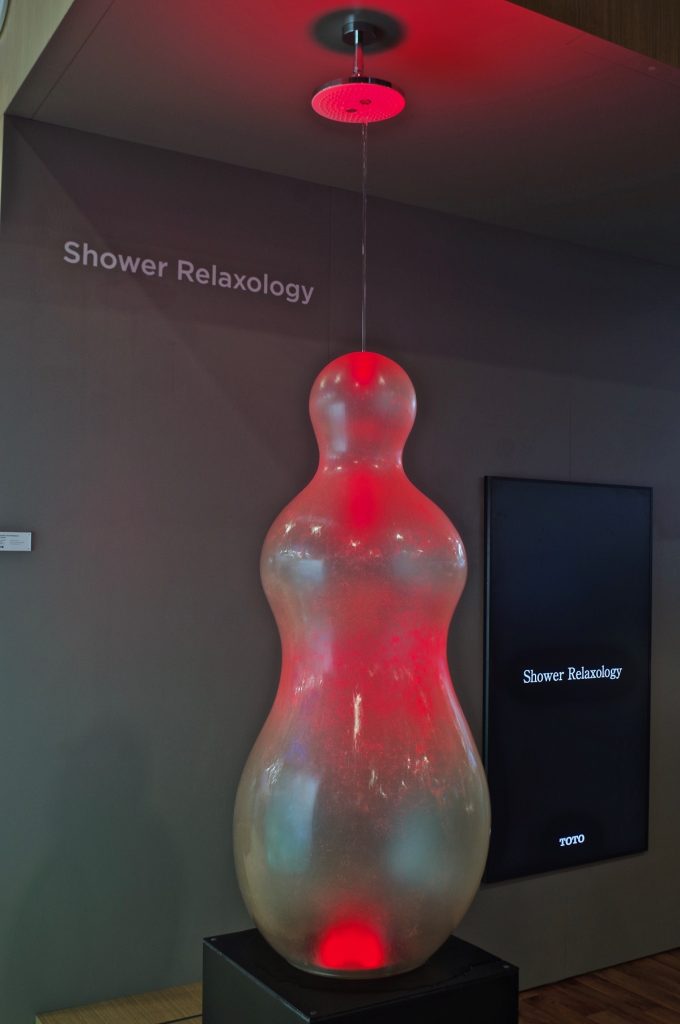
BRIAN SANTO: The other thing I walked past and avoided completely were the smart toilets. I mean, I don’t want to plug in my toilet. And frankly, I don’t want it to be that intelligent either!

NITIN DAHAD: Well, in Japan, when I went to Tokyo a few years ago, I did see some what you would call “smart toilets” maybe.

JUNKO YOSHIDA: It’s the issue of cleanliness. And the Japanese are meticulous about how clean it must be. So it’s not just about toilets, but how you clean yourself. Everything to do with personal hygiene. The Japanese are really meticulous about that.

NITIN DAHAD: I didn’t see the one in CES, but I’m guessing if they’re smart toilets, they’ll probably analyze your excretions to see sort of how well you’re doing.

BRIAN SANTO: I saw something like that last year. It had a camera, and it was AI-based, and it looked inside baby diapers and analyzed what had come out so you can presumably make better decisions about what goes in.`

JUNKO YOSHIDA: I think what it really comes down to is, just because you can, doesn’t mean it needs to have that technology.

BRIAN SANTO: Exactly.

JUNKO YOSHIDA: Yeah. That’s really too prevalent in CES. It’s just a little too much.

BRIAN SANTO: Yeah, I don’t know that I need to plug in a toothbrush just so that it can give me teeth brushing metrics.

NITIN DAHAD: I did actually try that. I went to the Proctor & Gamble booth and actually tried it. And for me, it was kind of a revelation, because the week before I actually did go to the dentist, and he told me off for not brushing properly. So what this actually did was actually allowed me to figure out where I wasn’t brushing right. So that map on the phone where I was and wasn’t. Because it’s using accelerometers and position sensors to actually determine where in the mouth it is relative to your start point. So then that’s how it measures where it’s going. Would I spend $200+ on that just to tell me if I was doing it right? Or should I go to the dentist and get him to tell me off? I don’t know.

BRIAN SANTO: Well, yeah, you’ve convinced me.

JUNKO YOSHIDA: Sold!

BRIAN SANTO: For the right price, maybe an electric toothbrush is worth it. So any other observations from your peregrinations around CES?

JUNKO YOSHIDA: You know, Brian, you should talk about what you found, actually, because it sounds essentially there’s a whole bunch of startups doing some interesting stuff. But a lot of times, do we need these technologies all crammed into The Sands? No offense to anybody. They are creative, but at the same time, it’s too much navel gazing going on. Too much information in my opinion.

But there were all sorts of surprisingly non-consumerish technologies on display at CES, right, Brian?

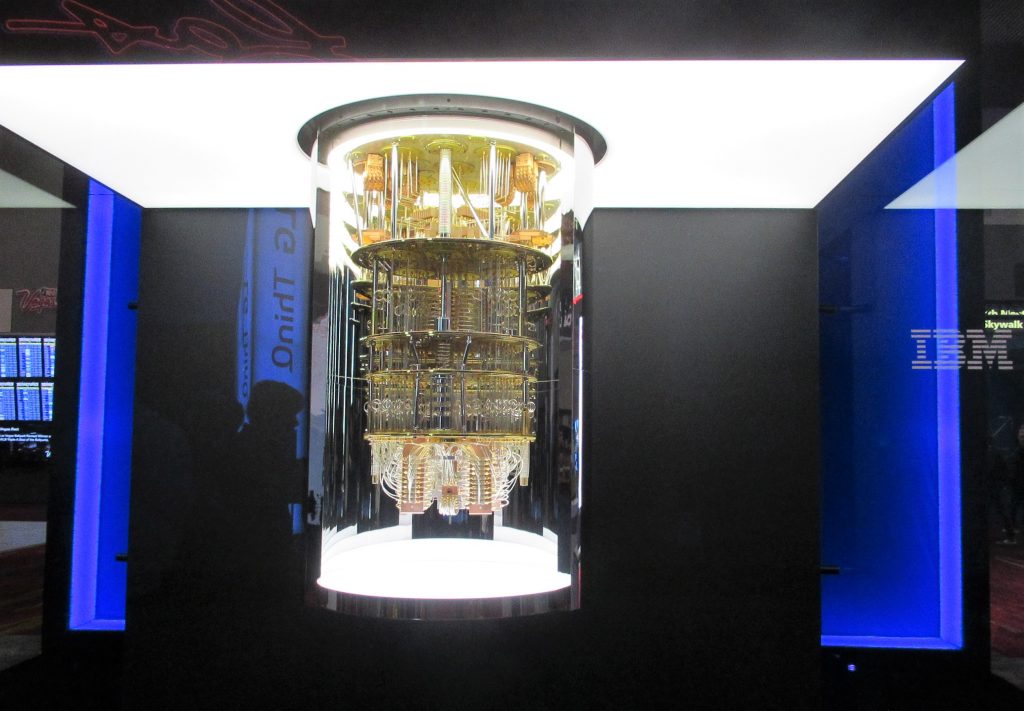
BRIAN SANTO: Oh, yeah. I was amazed by this. Really great to see, but there’s no way that the IBM Quantum computer can in any way, shape or form be considered consumer electronics. That said, for whatever reason it was at CES, it was cool to see IBM’s Q Quantum computer in the grand lobby there.

JUNKO YOSHIDA: That central hall.

BRIAN SANTO: It looks like something out of a sci-fi movie. I mean, it’s in this glass-enclosed case…

JUNKO YOSHIDA: Beautiful.

BRIAN SANTO: It’s beautiful! It’s cryogenically cooled; it’s vacuum sealed; it’s this gold, gleaming, tiered mechanism with pipes and connections, and they’re all symmetrically shaped and placed. Yeah, it’s just this wicked cool looking device. What IBM’s Quantum computer, Q, does, there are different ways to do quantum computing, but IBM’s Q takes a particular approach where they look at electron spin. The electron is the quanta, right? And the way it was explained to me is, you think of the electron as a globe, and you assign values to points on the globe. So it’s spinning on its axis. And the top axis, you assign that as a value of one, and the bottom axis, you assign the value of zero. And every other point around the globe represents some other value. And you’ve got like this almost infinite number of values between one and zero. So you physically add these electrons into the queue. And each electron is considered a q-bit, a quantum bit, a q-bit. And you cool them down progressively from physical layer to physical layer, from top to bottom. So the top layer in the machine is cooled to maybe a few Kelvin. And as you drop from tier to tier to tier, you’re cooling it more and more, to mili-Kelvins. And at the end, what happens is that the electrons are active and they get less active as they get cooled down. And they physically collapse as they move down through these tiers. And they collapse toward specific values. And IBM and the people, researchers, that they’ve been working with, they’ve developed these sophisticated algorithms that predict the behaviors of these electrons as they drop through the layers well enough to exploit the physical process as a kind of a model that they can model the algorithms on. Frankly, the mathematics are way beyond me. But the upshot is that you can do these amazing things with the IBM Q computer.

The example that they’ve been using for a couple of years is a caffeine molecule. Now, on a scale of molecules, caffeine isn’t all that complex. But modeling a caffeine molecule is way more sophisticated than most regular supercomputers can do quickly. And that’s what a quantum computer can do. It can do these amazingly sophisticated, highly complex calculations pretty rapidly.

Now that was known. But what was new was that IBM is building a quantum computing firm up in Poughkeepsie. They’ve got 15 of these machines there so far. And they’re providing access to them, as they’ve been providing access individually to each individual quantum computer. They’re still providing access. It’s sort of like quantum as a service. And one of the interesting things was, I asked the researcher there if you can gang these. And I’m not even sure why. And he wasn’t even sure why you might want to gang them up. But they’re exploring ways to make that possible. He was explaining there’s new research that allows them to take the quantum activity and switch it over to photonic so that you end up with optical computing to gang the 15 Qs or more as you go forward. It’s really fascinating stuff.

And then… Now for something completely different from a quantum computer. I wandered over to the John Deere booth.

JUNKO YOSHIDA: That’s a huge machine they have!

BRIAN SANTO: I know! It’s enormous!

JUNKO YOSHIDA: It’s a spray machine?

BRIAN SANTO: That’s it. So I’m mostly an urban kind of a guy. And walking into that John Deere booth, looking at all this farming equipment, I had to learn a whole new vocabulary. Like, What’s that big thing over there? And it’s like, Oh, that’s a combine.

JUNKO YOSHIDA: Let’s start from there, right?

BRIAN SANTO: Yeah. They had to train me from the basics just to talk to them about it. So what that was there was a sprayer. And a sprayer is an enormous machine roughly the size of a sanitation vehicle that picks up your garbage in cities. And it has on either side these two long booms. I’d guesstimate maybe 30 feet long. And set along these booms at intervals of like maybe eight or nine or ten inches were these spray nozzles. And those are for applying fertilizer or herbicide. So they’ve had sprayers that have had cameras on the booms for a while now, but what they’re developing now– and they think they’re about two years away with this thing– what they’re developing now is that they’ll have each nozzle with a camera, and each camera will have its own processor.

Now John Deere is becoming a tech company. They identify themselves as a technology company now. And they feel their strength is developing algorithms. So what’s coming is an AI-based sprayer. And the idea is, they’ll be able to drive these sprayers through the fields, and at the speed they’re going, they’ll be each boom, each camera will be hovering over any given plant for roughly about a third of a second. And in that time, this AI-based camera will determine whether it’s hovering over a soybean plant or a weed, or a corn stalk or a weed. And it’ll have that third of a second to decide which it is and whether or not to hit it with an herbicide.

Now the value of this is that they figure that they’ll be able to target herbicides or target fertilizers. With herbicides, they think that they might be able to cut down the chemical application. Instead of just spewing herbicides over the entire field, they might be able to cut their herbicide application down by 90%, just cut the chemical application by 90%. And with fertilizer, similarly, by being able to target the plants, they’ll be able to reduce the amount of chemicals overall that farmers have to use in the fields. Save money that way.

NITIN DAHAD: There’s one more thing about that, actually. Because it’s not just about their reduction of the chemicals. When you look at the bigger picture: growing population, world population, how do you feed them? From my travels, I’ve seen quite a lot on sort of figuring out precision agriculture. One of the startups I saw in Taiwan last year was doing exactly that. And they’ve got contracts in Europe to enable people to make it more efficient to make food, basically.

BRIAN SANTO: Right. Right. I sat in on a session about using technology to make people’s lives better. And the speakers included someone from the World Bank, which is investing in this sort of thing. Someone from the government of Bangladesh. Another person representing the government of Columbia. And the idea is to use emerging technologies like AI, like 5G, to improve people’s lives, to find out ways to do that. And it’s really inspiring.

JUNKO YOSHIDA: In theory, I guess.

NITIN DAHAD: Actually, no. There is practice now.

BRIAN SANTO: So the examples they gave in Columbia: People in Columbia are slapping up homes, in some cases, using whatever materials are at hand, and the problem is that many of these homes are substandard. And it’s questionable if they can stand up in an earthquake or stand up if there’s a landslide, or even stand up if there’s a hard rain. So the government’s goal is to spend money to help bring up the standards of some of these homes. But the question is, Which ones? They want to target their limited funds on homes that really do need to be brought up to par.

So what they’ve done is, they’re sending out vehicles, sort of like the vehicles you see that do the mapping for Google Maps, and it’s a similar idea. And what they do is, they take video, they take imagery of all of the homes that they pass by, and then use that to build a map of the communities that they’ve gone through. And then they apply AI to evaluate what each individual home, what the materials were used in building those, get a sense of what the condition of each home is. And by doing that, they can take those maps that they’ve made and figure out where within those communities they should be targeting their investment money. That’s just one example.

Bangladesh, for instance, they’re dealing with climate change. It’s a very exceptionally serious thing for Bangladesh, because if it’s not checked, if climate change is not checked relatively soon, roughly a third of the country could be underwater in a couple of decades. And as it is, natural disasters that used to come every 100 years or 500 years, these are coming like every year, every other year now. Floods, especially. So what they need is an early warning system. So they’re trying to use modern communication systems for communications. They’re trying to use AI for predicting where natural disasters might strike and how severe they might be. And that’s all for the purpose of setting up early warning systems.

So there are some really practical applications of all these high tech systems being employed right now, today.

NITIN DAHAD: The UK could possibly be underwater as well if it goes as well. Some coastal areas.

BRIAN SANTO: Yeah. New York City, Los Angeles, Miami.

NITIN DAHAD: You were talking about the homes and analyzing the materials to make sure that they’re safe. That actually brings us back to some of the technologies we talk about in EE Times, because I’m seeing people using things like sound and the resonant frequencies of certain materials to identify them. And radar, Vayyar Imaging is doing a lot of that where they’re getting the signatures of various things so that then they can do full detection, they can do lots of other things. I don’t have any interest in them. That just came to my mind.

It is about using all the different technologies we talk about in, say, things like autonomous vehicles, but they’re actually being used in lots of other areas as well.

BRIAN SANTO: I wrote a story a couple of years ago about the City of Pusan in South Korea. And they’re on the Sea of Japan. They’re at the confluence of two major rivers. They’re up against some hills. So they’ve got flash floods, potential for tidal waves, potential for landslides. So what they’ve done is, they’ve installed sensors all over the city so that they can get early warning for natural disasters. They can warn their citizens that whatever natural disaster might be occurring. It’s things like that. They are modern applications of high technology. It’s incredibly useful, helpful, can actually save lives, and it’s invigorating and exciting to be able to report on all of these technological advances.

I encourage you to check out our reporting from CES, which includes articles from the entire EE Times staff, some great photojournalism from David Benjamin, and several podcasts. Peruse the web site at eetimes.com, or take a look at the handy-dandy list of links we have on our web page dedicated to this podcast.

Welcome, everyone, to the year 2020. And now let’s leave it. It’s time to enter the Wayback Machine to revisit some of the great moments in electronics history.

On January 14th in 1914, that day saw the first product roll off the first industrial assembly line. It was, of course, a Model T automobile produced by the Ford Motor Company. The assembly line was one of the great innovations of the industrial age. A hundred years later, it’s one of the fundamental enablers of producing everything from computer chips to Pringle’s potato chips – which I deliberately mentioned because I only just recently found out one of those odd pieces of trivia that I live for. One of the people who helped create the machine used to create Pringle’s was author Gene Wolfe, perhaps best known for his four-volume “Book of the New Sun” series.

And okay, we absolutely have to include this one. On January 11th in 2001, Dave Winer, then the CEO of Userland Software, was the first to demonstrate a specific tag for RSS feeds that would pass the URL address of a media file to an RSS aggregator. He called the tag “Enclosure.” He created it at the request of former MTV VJ Adam Curry, who was experimenting with what – at the time – was called audioblogging. Audioblogging is now commonly referred to as podcasting. And here we are.

This month, we’re also celebrating the birthday of HAL the computer, which in the film “2001” reported that it became operational at the H.A.L. plant in Urbana, Illinois on the 12th of January 1992. His instructor was Mr. Langley, and Langley taught HAL to sing a song. If you’d like to hear it, you’ll have to watch the movie, because we don’t have the rights.

Finally, on January 13th in 1910, the first public radio broadcast was transmitted. The engineer behind it was Lee de Forest, whose Radio Telephone Company set up the transmission live from the Metropolitan Opera House in New York City. It was a performance of an opera called Cavalleria Rusticana, and it featured a tenor by the name of Enrico Caruso. The sound quality was said to have been miserable, but the broadcast radius was several hundred miles, reaching into Connecticut and heard by ships far out at sea. Here’s a separate recording of Caruso, captured also in 1910, singing an aria from that opera.

(ENRICO CARUSO)

BRIAN SANTO: That’s your Weekly Briefing for the week ending January 16th.

This podcast is Produced by AspenCore Studio and was Engineered by Taylor Marvin and Greg McRae at Coupe Studios. The Segment Producer was Kaitie Huss.

The transcript of this podcast can be found on EETimes.com. You can find a new episode every Friday on our web site, or via your favorite app for podcasts. I’m Brian Santo. See you next week.

Startling Views from CES

By David Benjamin

LAS VEGAS — Negotiating the CES show floor, bumping along among throngs of convention-goers, and weaving between display booths large and small is no walk in the park. But it rewards the visitor with sights, sounds, and the occasional human encounter that can be mystifying, gratifying, amusing. For a photographer more interested in startling images than in the minutiae of technology, this hectic stroll can be fun. Here’s a collection of shots derived from an hour or so among several exhibition halls at the Las Vegas Convention Center.

Quantum computing comes to CES

IBM chose CES to unveil IBM Q System One. IBM calls its Q System One “the world’s first integrated universal approximate quantum computing system.”

But here’s the thing: How do you explain quantum computing to the CES crowd? After all, the system is designed for scientific and commercial use.

The Big Blue did its best to describe quantum computing in the context of future applications. The potential use cases listed by IBM include: “finding new ways to model financial data and isolating key global risk factors to make better investments, or finding the optimal path across global systems for ultra-efficient logistics and optimizing fleet operations for deliveries.”

Le Mans comes to CES

Formula 1, the organization that sponsors auto races all over the world, has developed its own e-sports, including video games and a sports league. This allowed eager visitors at CES to drive, virtually, a Formula 1 car on a track that simulates a real race.

LG’s dazzling OLED

One of the most dazzling exhibits at CES, annually, is LG’s vast undulating OLED ceiling, some 50 yards from end to end, displaying vivid moving images of sea and land in brilliant color and hypnotic variety. To get an idea of the scale of this display, look for people in the lower left.

Sights and more sights

The point of every demonstration on the show floor is to pull people in and capture their undivided attention. The eloquent presenter at an LG LinQ smart-kitchen demo got this crowd to freeze in place and watch the whole act.

Flying autonomous taxi, anyone?

You kinda wish that Uber would nail down the robotaxi first, a kind that drives on streets, before jumping on a full-scale aircraft concept.

Nonetheless, a humongous flying drone got everyone’s attention at CES 2020.

Hyundai Motor Co. and Uber announced a joint partnership to develop Uber air taxis for a future aerial ride-share network. Hyundai became the first automotive company to join the Uber Elevate initiative.

What’s Hyundai’s contribution? The company claims that it is bringing an “automotive-scale manufacturing capability” and its expertise in “mass-producing electric vehicles.” Yeah, right. Let us know when the volume production will become the gating factor for flying cabs.

The ultimate in ultra-thin

Royole, a maker of ultra-thin display panels, turned its products into virtual leaves on a 25-foot artificial tree.

Nominee: dumbest corporate slogan

What? Was life that stupid up ’til now?

Panasonic: swimmers & stuffed animals?

Actually, Panasonic, whose history at CES goes back decades, is not sponsoring swimming races and making cute stuffed creatures. This was just a dramatic juxtaposition. The historic Japanese electronics company this year is featuring OLED displays, wireless headphones, and a collaboration with partner companies on Filmmaker Mode TV.

You don’t get the hunk

“Redefining Home” has been a mission for dozens of companies at CES for more than 20 years. Homex is one of the latest entrants, with what it calls an integrated home experience platform that understands each individual’s personal needs. But the tall, handsome guy explaining the technology doesn’t come with the package.

This is not a giant toaster

Progress has been made in the development of driverless auto technology, as indicated by this shuttle vehicle displayed by Bosch. But many of the advanced prototypes for autonomous people-moving still look eerily like upscale toasters on wheels. Bagels, anyone?

Konka’s 8K micro LED 

According to “booth babe” Sarah Trujillo, Konka is the only company, other than Samsung, with the capabilities for the wall-size mural it was displaying at CES. Sarah said this is the “commercial” version and did not say when you might be able to adorn your rumpus room with this sort of digital scenery.

China at CES in one photo

From a certain angle on the CES show floor, two Chinese powerhouses, Changdong and Huawei, are joined at the ceiling joists.

Who was that masked Huawei guy?

Convention-goers David Parker (left) and Tom Dahlstrom learn the intricacies of the latest Huawei smartphone from an amiable aide known only as Matthew V. For reasons that Matthew and other Huawei elves were not allowed to discuss — perhaps to protect civilians in a trade war — none of Huawei’s employees working in its booth at CES were identified by their full names.

Those people aren’t people

The display for Neon, a company based in Campbell, California, featured lively film footage of animated folks who aren’t actually folks. The images are 2D robots whose purpose, according to neuroscientist Angie Chiang (in the foreground — she’s real!), is to accustom us to artificial people who seem, said Angie, “as real as possible.”

A place in the sun

Las Vegas, located in the desert, has precious little green space. But there is a patch of it in front of the Las Vegas Convention Center, just large enough for a few weary visitors to take a break from the CES hurly-burly.

Elon Musk goes underground

One thing that was not on the show floor, but everyone talked about at CES 2020, is a new people mover currently in development by Elon Musk’s Boring Co.

The Boring Co. is constructing an underground people-mover system beneath the convention center. The loop is designed to connect the current LVCC with a new convention building under construction across the street. Supposedly, it will turn an estimated 15-minute walk into a 1-minute ride.

CES attendees next year will be traveling in one of three Tesla model vehicles that can carry up to 16 people each. The cars are slated to operate autonomously in the tunnel. Las Vegas Convention and, reportedly, Visitors Authority CEO Steve Hill said this week that the loop is on track to open for CES 2021.

Multi-Finger Authentication Strengthens Smartphone Security

By Anne-Françoise Pelé

Fingerprint biometrics have become a standard security feature on smartphones, but consumers demand more from technology to securely make online shopping, banking transactions, and bill payments. For France-based Isorg SA, multi-finger authentication is the next phase in smartphone identity recognition.

At this year’s Consumer Electronics Show, Isorg is demonstrating a full-screen fingerprint-on-display sensor module for multi-finger smartphone authentication. It supports up to four fingers simultaneously touching a smartphone display.

More fingers, more secure
A spin-off from the CEA-Liten research institute in 2010, Isorg has developed the organic photodetector (OPD) technology, which integrates printed photodiodes on different substrates to enable large-area image sensors. It is compatible with plastic or glass substrates using TFT technology or CMOS image sensors.

(Image: Isorg)

In response to OEMs’ and end-users’ demand for a higher level of smartphone security and privacy, Isorg designed a fingerprint-on-display (FoD) module that supports one- to four-finger authentication across the entire dimensions of the 6-inch smartphone display, or even larger. Such multi-finger authentication capability aims to strengthen security for mobile banking and payments, personal health monitoring, and remote home control applications.

Why four fingers, and not five? “The logic behind ‘more fingers, more secure’ lies in the fact that the more fingers, the more fingerprint data to be matched, making it more complex to crack,” Jean-Yves Gomez, Isorg’s CEO and co-founder, told EE Times. Five-finger authentication is possible; however, “we promote four fingers instead of five because it is more user-friendly. It is easier to enroll your index to small fingers at the same time; while adding your thumb, you have to adjust your hand position.”

Flexible and foldable displays
Isorg’s FoD module is compatible with flexible and foldable displays for smartphones and wearables. “It supports curved-edged phone displays with flexible polyimide-substrate sensors, and this slim fingerprint module is thinner than 300 µm,” Gomez confirmed. “These advantages made it easily integrated into slim smartphone and foldable displays.”

Isorg’s module can be used both for indoor and outdoor environments, as it demonstrates “robust performance under various conditions, including sunlight, web, and dry fingers as required by smartphone OEMs in different test conditions,” he said.

Designed for smartphones, the full-screen FoD module could be extended to other applications such as wearables, tablets, and other similar under-display applications. The technology can also find applications in the biometrics industry (e.g., access control, border control).

The French startup said it will be sampling its FoD module to smartphone OEMs in spring 2020. Asked when we should expect to see the first smartphones implementing this module available on the market, Gomez said, “Our lead customers who are developing new smartphones are aiming to launch their products soonest. The exact new product launch will be decided by the customers based on their marketing strategy.”

Mass production in 2020
“2019 marked an important revolution for Isorg,” said Gomez. “We integrated other skills because the company has developed its own optics components and ICs for sensors. The journey we embarked on has brought us to where we wanted.”

Back in 2018, Isorg raised $26.6M (€24M) in Series C financing to conduct the different qualification steps of its production site based in Limoges. Two years later, “we are delighted to announce that the company is fully ready for mass production of our solution within 2020. We have had our products ready for commercialization and market expansion.” On the Limoges site, Isorg has a Gen 3.5 (780 × 650 mm) manufacturing line for image sensor production with supply of TFT backplane.

Headquartered in Grenoble, Isorg has a pilot line and a dedicated application team at the CEA-Liten institute. The startup also runs a small R&D line, compatible with 8-inch silicon wafers in Bordeaux, as well as sales and application offices in Hong Kong.

Isorg owns more than 60 patents and employs 70 people.

How 5G Will (Eventually) Change Your Life

5G is here, according to Qualcomm Inc. President Cristiano Amon. At least the technology is.

“2020 will be the year that 5G scales,” Amon told an assembly at CES 2020. “We are very happy to see that the industry has progressed so that today – even if you want to use it with 4G while waiting for base stations to be built—the best 4G phone on the market today is 5G.”

5G, CES 2020,
Molly Wood, senior editor for Marketplace Tech, interviews Qualcomm’s Cristiano Amon

Consumers can be forgiven if they haven’t noticed the change. The infrastructure that delivers long-awaited gigabit speeds, low latency and unlimited data hasn’t been built yet.

The transition is starting to happen — operators are deploying small-scale 5G networks the U.S., China, Korea, Japan and Australia. “The network is moving from pilots to initial launches in metropolitan areas,” Amon said. “I think it’s fair to say in 2020 you are going to see 5G in most major cities in the U.S. We are now the process of building coverage.”

Qualcomm’s San Diego campus and its surrounding neighborhood has 5G, he noted.

“What’s really happening – what’s pacing the scale of coverage – is 5G requires more sites and more towers,” Amon explained. “The situation, especially in the United States, is operators have to negotiate municipality by municipality – sometimes neighborhood by neighborhood — how to get new sites. It takes a very short time to deploy a base station – it takes a very long time to get new sites.”

Ironically, the same public that’s impatient for 5G doesn’t like sprawling towers and power-sucking industrial buildings in their backyard. 5G requires a dense infrastructure.

“On one hand, people say they want 5G and ‘where is my 5G, but I don’t want sites in my neighborhood,’” Amon said. “The two things are not compatible.”

Local politics aside, the 5G build-out is taking place alongside 4G. The change will be gradual.

“The first thing [consumers] are going to see is you have much higher speeds – an order of magnitude increase – and lower latency,” said Amon. “Some of the services you use every day will be much better.” Similar to 4G’s impact on streaming music, video will be the game changer – literally — for 5G.

5G will be the main platform for video distribution, Amon explained. “You will have a reliable connection to view news and sports and [5G] will finally deliver on user-content generation. Everyone will become a broadcaster because you have the speed to upload high-quality video to the cloud.” Microsoft and Google are predicting mainstream gaming will move away from consoles and on to smart phones. “Gaming will become a thing of the mobile industry,” Amon said.

Phones will remain 5G’s preferred delivery system. Qualcomm foresees companion devices springing up for a wide range of applications. “Today we know, even with some of the chips we are making, the limitation is the size of the screen. We have the processing power, and with the power of the hyperscale cloud, you can do almost anything. The only limitation is still the size of the screen.”

Wearable technology bridges those gaps. Device makers envision eyeglass-sized screens containing cameras, AR and facial-recognition capability. “I like to describe it as, you walk into a meeting and with facial recognition, you go immediately to the cloud and scan social media networks to get information on all the people you’re going to meet,” Amon said.

The automotive industry will see the biggest transformation with the advent of 5G. “This will range from upgrading your fundamental navigation system and ADAS as the car is connected to other cars and pedestrians and the cloud,” Amon explained. “You can populate a map with the location of all these things and how they move or how fast they move and use AI to make predictions. This is going to significantly upgrade ADAS and autonomy.”

Consumer demand – and investment – will accelerate the infrastructure  build-out, Amon suggested.  “The elevator pitch on what 5G  does –  connecting whatever device you have, phone to cars to the IoT —is based on technology that has a very wide pipeline that connects to the cloud 100%  of the time. No matter what devices you have, you can connect two systems and have unlimited storage and unlimited data.”

5G is no longer the exclusive technology of the mobile industry, he concluded. “It’s part of the automotive conversation, it’s part of the IoT conversation, it’s part of the computing conversation. We have to count on all those companies sharing those visions. We are just at the beginning of this great transition.”

Toto Touts Total Toilet

By David Benjamin

LAS VEGAS — If you don’t think there’s serious science in the development of the total toilet, you haven’t talked to Bill Strang, president of operations and e-commerce at Toto USA. Toto’s newest superjohn, the Neorest NX1 dual-flush “smart washlet” partakes of hydrophilic science, lubricity studies, and tribology to counteract the modern porcelain indoor flush toilet’s worst enemy — hydraulic adhesion.

In sum, a lot of thought has gone into Toto’s latest pride and joy, partly because — as Strang notes with a knowing smile — the Japanese, some of whom started Toto, are “fanatical” about bathroom hygiene.

“Everything we’ve learned through all the years of developing washlets has brought us to the ultimate washlet,” said Strang. Toto’s booth at the Consumer Electronics Show (CES) was large but tastefully uncluttered. In perhaps a gesture of Zen minimalism, rather than display Toto’s vast product line of bathroom fixtures, the company focused on the new Neorest NX1.

“It’s functional, with a great aesthetic, sort of like a river rock,” said Strang, summoning up his own Zen sensibilities, “with a nice organic feel.”

Toto is one of a host of household fixture, plumbing, and appliance companies displaying products that feature advanced material science and vastly improved performance, many of them integrated with artificial intelligence (AI) elements.

In an animated demonstration, Toto shows how the Neorest washlet employs the power of what it calls a “cyclone flush,” which actually makes a U-turn before swirling around the bowl furiously and sending all those colored cubes off to the treatment plant.

Strang rattled off the many virtues of the Neorest washlet, including a keenly engineered ceramic surface to which nothing can stick (all that lubricity), and a post-flush “wand” that thrusts itself into the bowl to do a second cleanup. The new washlet is, of course, heated and intuitive. The seat will lift when it senses anyone approaching. Its “bidet function” is a complicated mix of firm and gentle spray that oscillates, sometimes soothingly and sometimes more aggressively, Strang noted. A remote control manages all the washlet’s functions.

Included in the hardware is a second nozzle, “for girls, in the front,” said Strang. “It’s softer and more comfortable.”

He summed up Toto’s development of a toilet that goes way beyond “minimal” as the result of a “scientific approach for cleaning yourself efficiently, for a more comfortable and delightful experience” in the bathroom.

Strang added to the discussion by describing Toto’s collaboration with good2go, a San Francisco company that is installing safe toilets, accessible only with a QR code provided through a subscription-based smartphone app, in locations like Whole Foods and Peet’s Coffee. Trials of these toilets have been successful, with favorable responses from users and a drastic reduction in “toilet incidents” like drug abuse and assault.

Toto is also partnering with Georgia Pacific, a supplier of toilet tissue and paper towels, to monitor use of restrooms in large venues like stadiums and airports. An AI-based system being tested at Hartsfield/Jackson Airport in Atlanta has yielded new efficiencies in restroom maintenance, better morale among custodial staff, and “actual empirical data for building better public bathrooms.”

In short, Toto’s commitment to good toilets is total.

Toto has devised a shower, composed of a single stream, that doesn’t splash and, according to spokesman Bill Strang, massages the user gently while wreathing his or her body in a gentle flow of water.

Future of Technology in Racing: A Formula 1 Driver’s Perspective

By Nitin Dahad

LAS VEGAS — As my colleagues have written from CES 2020, automotive technology has somewhat dominated the conference here in Las Vegas. While there’s no doubt that advanced driver-assistance systems (ADAS) have come a long way and there are still roadmaps to go even further to improve driving experiences and safety, the question in my mind is: How far do we go with fully autonomous vehicles?

Even in the age of digital native youngsters, the camp is divided. On the one hand, there are 20-something-year-olds who stick to their belief that they will never need to drive cars, as everything will be autonomous, and in the age of Uber and Lyft, why would they ever need to drive a car? And then there are still driving enthusiasts.

We managed to catch up at CES with someone from the latter camp, 20-year-old Formula 1 driver for McLaren, Lando Norris, a strong driving enthusiast right from his early school years. Clearly, technology is an important part of the engineering of modern racing cars, almost to the same levels of advanced electronics and communications systems as in modern commercial aircraft.

Lando Norris explained how technology, and particularly live real-time data on all aspects of his drive, is a vital part of modern racing. As a top-tier racing driver, everything evolves around the technology.

He told EE Times, “One of the biggest things that helps me to drive is to be able to compare data. So we have live data while driving on track, which is relaying back to the engineers and the whole team, which they can then relay back to me, telling me where I need to go better and when I’m not doing good enough.” As a result, this helps him to improve constantly.

And in a race environment, one of the most useful parts of his technology arsenal is the radio — where he can talk constantly to the team to change things on the fly as he drives.

We asked his thoughts on what might be next for motor sports and technology. He said, “It’s going to advance a lot.” He jokingly added, “I don’t want it to advance too much that it puts me out of a job.

“Things will advance, but you don’t want to be changing what Formula 1 is. It still has the characteristic of someone, a human being, driving around a racing car as fast as they can. You don’t want anything to be too automated. Everything will improve, efficiencies will improve, data will improve, but I still want to be able to drive a racing car, in control of brake, throttle, steering, sliding the car around and having fun. In every aspect, it’s going to get better and move forward, but Formula 1 and my passion is driving a car as fast as I can.”

To me, that says a lot. There are some people that like driving, like Lando Norris. And there are others who can’t wait for fully autonomous vehicles, whenever that might arrive.

But it also leads to the question about what we automate and how far we can go, as well as the limitations of technology. In motor racing, you can have all the driver assistance you want. But the human can still control the destiny and the difference between winning and losing.

Last year, I had visited Oulu in Finland, and part of my program involved looking in on a global drone-racing competition. It had all the razzamatazz of Formula 1, with drones whizzing around the stadium at breakneck speeds and crashing into each other and into the side netting. But they were still being controlled by human “drivers” from the sidelines.

Maybe they could have gone fully autonomous with sensors to ensure that they don’t crash into other drones or the sides. But the problem at those speeds is likely that the response times in the electronics and sensors are not fast enough.

And in the world of motor racing, while Lando Norrris clearly has a passion for driving really fast, it may still be some time before the huge amounts of processing and the sensor-actuator response times are fast enough to cope with reacting at speeds of over 200 mph.

Bluetooth 5.2 SoC Extends Coin-Cell Battery Life Beyond Five Years

By Maurizio Di Paolo Emilio

Silicon Labs presented at CES a new system-on-chip (SoC) EFR32BG22 (BG22) that offers hardware and software stack combinations to meet market demand for battery-powered high-volume IoT products.

IoT is a reality present and used in the “consumer” world, with the adoption by consumers of many products/services already widespread from wearable items to “smart” appliances and upcoming transports, connected vehicles, and autonomous/assisted driving.

The advent of the IoT is steering the future of electronics toward a world where physical objects will all be connected and wireless communication will offer higher levels of freedom and flexibility. There is a growing demand for ultra-low-power wireless connectivity from consumers seeking to extend their wireless experience to compact electronic devices with small batteries. Bluetooth Low Energy (BLE) technology brings low-cost wireless connectivity to small, long-lasting devices. It was designed from the ground up to meet the need for energy efficiency and design simplicity.

Market analysts at the Bluetooth SIG predict that shipments of Bluetooth devices will grow by 26% by 2023 and that 90% of all Bluetooth devices will include Bluetooth Low Energy by 2023. The key requirements of the market are secure connectivity, i.e., that the devices work with only genuine and reliable firmware and extremely low power consumption.


Recommended
Silicon Labs Looks to Apply AI to IoT


Energy consumption in BLE SoCs is generally due to the processor and radio module. The processor can absorb several milliamps during operation. Some BLE radios may peak at 20 mA during transmission. Which part consumes more depends primarily on the application and duty cycle. Most BLE products are designed to sleep as much as possible to save energy, wake up to process, and send data.

With a high-performance, low-power Arm Cortex-M33 core (27 µA/MHz active, 1.2 µA sleep), the new SoC supports the new Bluetooth 5.2 standard, Bluetooth mesh, and direction finding with sub-meter accuracy. The SoC EFR32BG22C112 addresses high-volume and cost-sensitive applications. It has an operating temperature of up to 125°C and extends flash memory up to 512 kB. Target applications include low-power Bluetooth mesh network nodes, smart port locks, and personal health and fitness devices (Figure 1).

Figure 1: Silicon Labs BG22 Secure Bluetooth 5.2 SoC block diagram
Silicon Labs BG22 Secure Bluetooth 5.2 SoC block diagram

“From fitness trackers and health and wellness sensors to smartphone accessories and PC peripherals, low-power data transfer represents one of the biggest and fastest-growing application opportunities for Bluetooth Low Energy connectivity,” said Mikko Savolainen, senior marketing manager at Silicon Labs. “Silicon Labs’s EFR32BG22 Bluetooth 5.2 SoCs, announced this week at CES 2020, are ideal for these Bluetooth LE applications, as they require extremely low power consumption to maximize battery life, as well as compact size and the right price points for mass-market IoT products. The new BG22 SoCs provide an optimal combination of energy efficiency, wireless performance, security and software tools, and stacks to meet the market demand for high-volume, battery-powered IoT products.

“In addition to supporting Bluetooth LE data transfer, the SoCs are a great option for Bluetooth mesh low-power nodes and for direction-finding and asset-tracking applications requiring sub-1-meter accuracy. Bluetooth remains the protocol of choice for creating proximity solutions used for point-of-interest information, item finding, and real-time asset-tracking (RTLS) solutions and indoor positioning systems (IPS). BG22 SoCs support Bluetooth 5.1/5.2 direction-finding features, including Angle of Arrival [AoA] and Angle of Departure [AoD], and can be used to build some of the smallest, lowest-power asset tags and beacons as well as RTLS locators.”

Although IoT devices extend the functionality of various machines and components, at the same time, they increase the vulnerabilities of all devices connected to the network. New companies will need to pay attention and move on two fronts, the technological one to capture the potential and the security one to avoid compromising situations.

BG22 SoCs respond to an essential issue of IoT devices: security. The Secure Boot functionality of Silicon Labs with Root of Trust and Secure Loader offers a simple and efficient solution. SoCs support comprehensive fault analysis, allowing developers to investigate problems without erasing the flash. Developers achieve this through the secure debugging of Silicon Labs with lock/unlock encryption capabilities.

Panel: Global Leadership in AI Depends on Gaining Public Trust

By Sally Ward-Foxton

The support of the public is paramount to any country or region’s successful global leadership in transforming businesses, markets and economies using the technology, a panel discussion at CES concluded.

To start, the panelists, which included representatives from industry, trade associations, politics and government, were in agreement that leadership in AI is not a simple win-lose conundrum.

“I would not agree with the idea that it’s a zero-sum game, that one nation is leading and that it’s a race and someday you declare a victory, and then everybody else is a loser… I think everyone can benefit from the advantages of artificial intelligence,” said Lynne Parker, deputy CTO for the United States, from the White House’s Office of Science and Technology Policy.

Parker’s definition for a nation that leads in the field of AI is one with a lot of companies leading in terms of innovation, one with many leading universities in that field with cutting-edge ideas, and one with a strong innovation ecosystem which works closely with academia and the industry to foster innovation. The US is leading, according to those metrics, she argued.

“There will be winners, but maybe it’ll be first place, second place, third place, fourth place, and not winner take all,” said Michael Beckerman, president and CEO of the Internet Association. “From the companies standpoint, certainly [leadership] will come from innovation and the ability to put in place transparency and safeguards to ensure there’s not bias or discrimination through artificial intelligence, and ensuring that ethics are set up in a way that meets our common goals and standards… and from the government standpoint, making sure that policies are in place that both encourage and allow for innovation.”

These policies must ensure there are safeguards for both government and private sector use of AI, Beckerman said, pointing out that some of the riskier potential applications in terms of public trust are for government applications of the technology.

The panelists also agreed that consumer trust was of paramount importance, in a way that hasn’t been seen with other technology trends in the past.

“For both private sector and public sector use, you can’t truly win or succeed with AI deployments, with scaling AI, unless you have consumer and citizen trust,” said Adelina Cooke, North American AI policy lead at Accenture. “Any [leadership] race is going to need to engender trust among the population. When we are thinking about scaling [up AI applications], it’s not just feasibility and innovation, it’s making sure that you have the proper governance and responsible oversight within an organization [that’s important].”

Government Role
Panelists took different views on the role governments should play in increasing AI leadership in their countries.

The White House’s Lynne Parker described the US government’s hands-off approach to regulation of the use of AI technology.

“Certainly, I think at the beginning, the role of the federal government is not to get in the way,” she said. “We want to foster innovation and make sure it’s being used in ways we can all benefit from, but… there are many areas in which we need to have more oversight.”

AI presents a unique challenge, she said, in that there are many existing laws that protect Americans from things like discrimination, and the country has a robust legal system to help enforce these laws. If these laws are enforced at the state and local government level, companies have to deal with a patchwork of laws and regulations, which hampers innovation in every locale.

“At some point, the federal government needs to step up and say, okay, we’re actually hampering innovation by not having regulatory oversight or a process for it, or having any consistency,” she said.

The White House released a draft memo earlier this week which will establish consistent guidelines for regulatory agencies, which should help protect the public and also help the innovation ecosystem by providing companies with some predictability in terms of regulatory approach, she said.

Italian member of parliament Mattia Fantinati detailed both the European Commission’s approach and the approach in Italy.

The European Commission’s strategy for AI leadership is based several key ideas. These include boosting technological and industrial capacity, uptake of AI across the economy with private-public partnerships, being prepared for the socioeconomic changes which will happen quickly, and ensuring a legal and ethical framework for innovation to flourish within.

Italian initiatives for adoption of AI are focused on small and medium enterprises (SMEs), reflecting the country’s economy, he said.

“Most developed countries have adopted an AI strategy that reflects their social and political system,” he said, noting that Italy is home to many SMEs in manufacturing and handicrafts. “My role is to… create a collaboration between the masters of handicraft and artificial intelligence. It’s not easy, but we have to do it, because the European strategy is focused on the SME.”

The European Commission’s strategy includes using public funding to stimulate private investment, particularly with early-stage startups.

USA vs. China
Asked by an audience member about Kai Fu Lee’s 2018 book “AI Superpowers: China, Silicon Valley and the New World Order” in which he details China’s strengths in this arena, Parker again referenced the importance of public trust.

She mentioned Lee’s postulation that China is very good at taking existing ideas and implementing them.

“At the same time, I think we, as the free world, also care about exactly how these technologies are used,” she said. “We want to make sure that we don’t use the technologies in ways that are inconsistent with the values of our nations.”

Ad block